
To Kill a Mockingbird (Graphic Novel) Adapted by Fred Fordham

In 1960, To Kill a Mockingbird was published under the pen name, Harper Lee. This would go on to be her legacy, having published one novel, until the first draft of the well-known work would later be printed in 2016 and titled Go Set a Watchman. This took place while Lee was in a nursing home unable to consent to this publication, which many people think is a sequel to her famous novel, leading to outrage and disappointment.
To be clear, To Kill a Mockingbird was my favorite book I read for school and was a big stepping stone in cultivating my passion to write. Women wrote back then? Who knew? I can write, too! Harper Lee’s death stands to be the only “celebrity death” I have cried about and written about. Thus, I come to this graphic novel both loving the medium and the original text and the mindset of, “Please don’t make me hate this.”
I didn’t. Hate it, that is. The illustrations and color are beautiful, and the pages are thick and crisp. It doesn’t get much better than that, right book lovers? However, I love the novel as a novel and expected the graphic rendition to be written more to the style of a graphic novel: intricate artwork that stands in place of longer text, sequential images without interruption, and a variety of paneling choices.
While the book has these moments, they are far and few between. There is a lot of text that can be a turn-off to younger readers promised a comic-book-like experience. I understand the desire to put the entire novel into his new rendition and to stay true to Lee’s text—believe me, I know—however, this book seeks to do so by putting in too much dialogue to the point of a few monologues. The speech can be cut down and replaced with images that show expression or the dynamic between Scout, Dill, and Jem.
Also, I love graphic novels for how the illustrator uses paneling and white space across the spread. For most of the book, Fordham does not use these methods to his advantage. Rather, there is a consistent 7-9 panel page for most of the book. I love when images jump out at me, and there were some, but I also love when they jump out of their panels and seemingly come to life, which is only done one or two times. It is a technique that shouldn’t be used all the time but could’ve been done to make some dramatic scenes really pop.
Yes, I do love this rendition of To Kill a Mockingbird. Does it have to do with my previous love for the original novel? Oh, most definitely. Though, I love the medium and I think Fordham did the text justice (get it, because Atticus is a lawyer!). I also believe this is a great way for students to get into this 60-year-old text. My middle schoolers love graphic novels and comics! This is a lovely chance to meet halfway and say, “Let’s talk about it.” From race to our criminal justice system to gender norms, this book has it all and depicts it visually so all students can access the story.
Please do be aware of the author’s note in the back that discusses the way the characters speak and the use of n—.
Find To Kill a Mockingbird by Harper Lee here!
Find To Kill a Mockingbird Adapted by Fred Fordham here!

Speak: the graphic novel by Laurie Halse Anderson and Emily Carroll
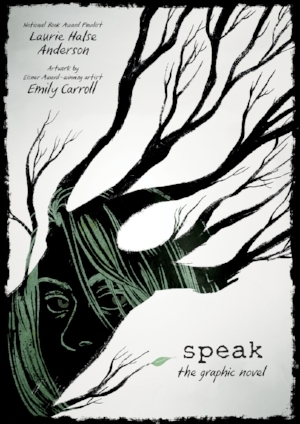
Speak by Laurie Halse Anderson is a personal inspiration of mine, let alone a widely acknowledged canonical novel of modern times. And now, with the artistry of Emily Carroll, it has become a graphic novel. Carroll’s black-and-white drawings bring a rough and edgy atmosphere to the text, emphasizing the interiority during the scenes in which Melinda vividly recalls what happened to her the night of party. Carroll takes these moments and gracefully yet devastatingly depicts the horror in a way that is frightening but may not be as triggering for some readers as they would think, though anxiety still rattles the bones.
As a whole, Speak: the graphic novel reads much like how a movie adaption would be seen. The main character is much more melodramatic, but somehow we still lose much of Melinda’s interiority about the incident that shakes her to her core. The graphic novel seems to revolve so much around other subplots and Melinda’s external relationships that the main plot of the assault is buried. If I hadn’t read the original Speak, I may have forgotten the main point of the novel. First, there’s the new girl Heather, losing Melinda’s old friends, art class and drawing trees, Melinda’s poor grades, family dysfunction, in-school suspension, rules of the school and bullying, etc. There’s so much that distracts the reader from Melinda and her journey of recovery that is more focused in the original novel that is missed in the graphic novel.
My guess, as a reader and a part of the industry, is that the goal of Speak: the graphic novel is to grasp onto the gaining popularity of graphic novels at the current moment, capture the new generation of readers, and gear them toward reading the original Speak. I’m not against this method. I think this is a great way of repackaging a modern classic, but lovers of the original novel shouldn’t expect grand changes but enjoy the wonderful artwork by Emily Carroll.
This novel is still relevant today. Teachings of consent is still needed today. If you haven’t already gotten your hands on one of them, I highly recommend one or both of these books.
Find Speak: the graphic novel here.

Burro Hills by Juila Lynn Rubin with Interview!

Burro Hills by Julia Lynn Rubin is a ferociously wild ride, one that will leave you with whiplash but also wanting more! With an eccentric cast of characters, there is never a dull moment in this town. From high school gossip to household dramas to drug trafficking, we follow an unexpected group and are given small breaths of reprieve throughout the novel. In this way, it almost feels like the reader is on this high with the characters, mimicking the bursts of adrenaline.
The story follows Jack, who sticks with his pot-smoking crew and his other best friend Jess. However, the new kid, Connor, rattles the status quo of the group, tearing Jack’s attention away from his friends. Connor seems to know exactly who he is: a kid who gets into trouble—oh, and he’s bisexual. On the other hand, Jack absolutely doesn’t know who he is. By spending time with Connor, Jack opens up and reveals to himself who he really is.
However, what about his old friends? They don’t forgive him for ditching them. And in a town riddled with homophobia, crime, and vengeance, there is no safe space for Jack—not even in his own home, where his dad is a drunk and his mother has a problem Jack cannot understand.
The following is an interview with author Julia Lynn Rubin:
CL: Congratulations on an amazing debut novel! Each character has so much depth, and they all jump off the page as realistic people. What made you write about a group of teen boys?
Julia Lynn Rubin, photo via www.julialynnrubin.com
JLR: Thank you so much! That is such high praise and I’m so flattered! I think I’ve always been fascinated by teen boys and why they say what they do, act how they act. It wasn’t a conscious decision when I first started the novel, but as I kept writing, it evolved into this deep-dive exploration of toxic masculinity. I had a lot of fun with their dialogue and characterizations and making them as “awful” as possible on the surface, while examining how sensitive and confused they are underneath all that exterior bullshit. Basically, in different circumstances, these boys wouldn’t be “bad.”
CL: This was a very interesting read for me since I know you personally. So I want to know which character you think you align with the most and why.
JLR: It’s definitely Jack. He’s the most autobiographical character to me, emotionally at least. I remember my dad read an early draft of the book back when it was a dual point-of-view between Jack and Jess, and he said: “You’re not Jess. You’re Jack.” That stuck with me, and helped inform my decision to make him the sole POV character when my agent and I were revising. He’s sensitive, anxious, thoughtful, observant, and a little too wrapped up in his own interiority to the point that he sometimes misses the obvious and misreads the situation. His cognitive distortions are all too familiar to me.
CL: You really put these characters through the wringer. People say to make your characters go through hell, to make the worst possible things happen to them in order to incite drama and conflict, and you do exactly that. Was there ever a moment in which you or your editor thought there was too much going on that the story would be found unbelievable? Did you have to pull back?
JLR: I remember revising and thinking, “I feel so bad for what I’m doing to these characters.” I even said that to my editor at one point. There are a handful of scenes and moments I kept second-guessing, wondering if I should put them in a YA novel since they’re so damn disturbing (though I know teens can totally handle it). But it’s true, you really have to up the stakes, especially in a character-driven story. And these characters are teenagers, so everything feels very life and death to them, very immediate and all-consuming. I actually had a few major scenes that I ended up either cutting or completely rewriting because they didn’t feel as believable in retrospect. I don’t want to spoil anything, but the whole final scene with Toby’s family was originally much different and maybe a little unrealistic and unsatisfying. I also spent a lot of time with my editor fleshing out Jack’s parents and making them feel like fully realized people, less like caricatures. But I never really pulled back, no.
CL: Now, I know you from The New School in New York City and we both also spent time in Pittsburgh, PA. From where did come up with the setting of Burro Hills? Is it based on anywhere in particular?
JLR: Yes! Small world. Actually, growing up on the East Coast made the decision to set the book in Southern California all the more tantalizing. I’ve always been fascinated with the West Coast and the climate and culture of Southern California. In high school I wanted to go to film school and move to L.A. and become a director. I visited with my mom to check out colleges and I was totally enamored. That’s probably where that setting originated, that and the way Janet Fitch describes it in White Oleander, a novel I’ve re-read many, many times. But I created a fake town so I wouldn’t offend anyone! The setting is also based on my perception of urban sprawl and dying towns and nowhere places; the beauty in the ugliness of America.
CL: In this book, there are themes of sexuality, friendship, broken families, drug use, coming of age, and so much more. What would you most like your readers to get from reading this book?
JLR: I think the great thing about books is that each reader takes away what they need to and sees what they want to see. I love that about art. I know everyone is going to have a different experience reading my book, but I really hope those who read it – teens especially – come away with a sense of being seen, and heard. And hope.
CL: Can you reveal what’s coming up next for you?
JLR: I’m currently on submission with my second YA novel (which I wrote at The New School), so fingers crossed that one lands somewhere!! I also have another YA in the works that was my MFA thesis, and an idea for a fourth. So basically I’m going to keep promoting my debut and writing and hoping and praying.
CL: Thank you so much, Julia, for answering these questions! I can’t wait to see what you do from here.
JLR: Thank you so much for having me! These were excellent questions.
Find Burro Hills here.
Follow Julia Lynn Rubin on Twitter!

Emergency Contact by Mary H. K. Choi

Mary H. K. Choi’s YA debut novel Emergency Contact starts with Penny Lee going away to college, making this book perfect for older readers of the genre. We are no longer in high school but get a taste of freshman year in a completely different context. Penny’s roommate, Judy, is the pinnacle of a spoiled rich girl. Judy’s best friend, Mallory, is by association, a roommate, as the two friends are basically attached at the hip.
Much of the emotional and romantic inclinations are similar to those of younger people. I mean, college freshmen were just high schoolers four months ago. Penny is a sci-fi/fantasy writer and still feels like the “goth kid.” Penny is regimented, waking up early to write while Judy is asleep, attending all her classes, and of course avoiding her really vicarious mother Chloe.
However, when Judy invites Penny to the coffee shop, she meets Judy’s uncle, Sam, a young twenty-something taking film classes to become a director. Sam has tattoos. Sam is older. Sam wears the same shoes as Penny. Penny is in awe. But none of Judy’s friends can date her uncle (though he is no longer, as that divorce happened a while back)! That’d be weird.
When Penny finds Sam in deep distress one night, she takes care of him and brings him to the coffee shop, which, unbeknownst to Penny, is his home. From then on, they become each other’s emergency contact. They talk about what they’re working on and their lives, especially when one needs an ear to listen (or read—most of their communication is via text, which does sometimes get a tad confusing).
It’s sweet how they rely on one another and we see their relationship blossom into one of dependency, though it fosters reliance as the foundation of their romance, which made me wonder how healthy this whole thing is. But I fell for it anyway! They’re each other’s rocks, and once they meet again in person, their relationship becomes more real rather a strange Internet-type of romance. This novel is definitely character-driven, though there are plaguing obstacles the two deal with together and separately. If you’re into a book with a witty voice that makes you laugh at the seriousness of life’s woes and love artistic quirk, you’d be totally hooked by Emergency Contact. Escape from your own worries, and dive into theirs. At least for 400 pages.
Find Emergency Contact here.

Lumberjanes: To The Max Edition Volume 1
Lumberjanes To The Max Edition Volume 1
Written by Noelle Stevenson & Grace Ellis
Illustrated by Brooke Allen
Colors by Maarta Laiho
Letters by Aubrey Aiese
Design by Scott Newman
Forward & Afterward by Raina Telgemeier

With Maarta Laiho’s bold palette of colors, Lumberjanes is a punchy, quirky, and punny comic book series that focuses on five Lumberjanes (basically, the Girl Scouts but with Boy Scout woodland activities), who can’t seem to ever follow camp rules. There is always something more interesting to pursue than staying in the Roanoke cabin, like fighting holy kittens, were-bears, and a river monster.
Using the qualities that make up a true Lumberjane, as stated in the pedantic field manual, Jo, April, Molly, Mal, and Ripley try to beat the mysterious creatures before their cabin leader, Jen, can find out they’re gone. This is a true case of drama finding them. Pretty soon, even Jen is roped into the mayhem when one of the Lumberjanes turns out to be a mythological character bent on beating her brother to obtain ultimate power over the world. Now the girls of the Roanoke cabin have to save all of humanity from a couple of greedy gods.
In the first volume of The Max Edition, young and older readers will laugh out loud at the characters’ antics and will flip through the pages to find out what havoc is on the next spread. With a twist on gender stereotypes and a subtle romance, Noelle Stevenson, Grace Ellis, and Brooke Allen’s Lumberjanes is all about “Friendship to the max.” And, of course, earning those cool camp badges. Lovers of Noelle Stevenson’s Nimona (HarperCollins) will also enjoy this feminist, kick-butt series.
Find Lumberjanes To The Max Volume 1 here.