
The Only Worlds We Know by Michael Lee

Michael Lee’s second book of poetry, but first full-length text, The Only Worlds We Know, does not disappoint. If you are a fan of his spoken word artistry, you will love a plethora of poems in this longer book. As a huge fan of Lee and his work for many years, I read this with a loving bias, sometimes reading the poem in his voice and other times my own. Though, I also have the audiobook version of The Only Worlds We Know, which is entirely read by Michael Lee. It is lovely and haunting in a different way than the text.
True to his style, Lee’s poems can rattle your bones merely with words. From “The Pill”:
The pill a solar system
in the dead man’s eye. The pill
a white shadow dragging night
behind it.
From “Look”:
Eventually, everything that can look will look
away, and our memory, which is a kind of faith,
will be unable to carry even itself.
With experimentation with erasure poetry as a multi-poem series scattered throughout the book, you can see Lee’s growth as a poet. He also plays with white space on the page: “The Study of Doors and Knowing” includes an entire page that engages tension with white space and mere dots. Lee shows that poetry extends beyond words to the words left unsaid.
Michael Lee is known for writing about his previous addictions, mental health, and the premature death of his childhood best friend. Somewhere in these pages is comfort for human pain and the need for guidance. It is beautiful and painful and hopeful.
Find The Only Worlds We Know here!

To Kill a Mockingbird (Graphic Novel) Adapted by Fred Fordham

In 1960, To Kill a Mockingbird was published under the pen name, Harper Lee. This would go on to be her legacy, having published one novel, until the first draft of the well-known work would later be printed in 2016 and titled Go Set a Watchman. This took place while Lee was in a nursing home unable to consent to this publication, which many people think is a sequel to her famous novel, leading to outrage and disappointment.
To be clear, To Kill a Mockingbird was my favorite book I read for school and was a big stepping stone in cultivating my passion to write. Women wrote back then? Who knew? I can write, too! Harper Lee’s death stands to be the only “celebrity death” I have cried about and written about. Thus, I come to this graphic novel both loving the medium and the original text and the mindset of, “Please don’t make me hate this.”
I didn’t. Hate it, that is. The illustrations and color are beautiful, and the pages are thick and crisp. It doesn’t get much better than that, right book lovers? However, I love the novel as a novel and expected the graphic rendition to be written more to the style of a graphic novel: intricate artwork that stands in place of longer text, sequential images without interruption, and a variety of paneling choices.
While the book has these moments, they are far and few between. There is a lot of text that can be a turn-off to younger readers promised a comic-book-like experience. I understand the desire to put the entire novel into his new rendition and to stay true to Lee’s text—believe me, I know—however, this book seeks to do so by putting in too much dialogue to the point of a few monologues. The speech can be cut down and replaced with images that show expression or the dynamic between Scout, Dill, and Jem.
Also, I love graphic novels for how the illustrator uses paneling and white space across the spread. For most of the book, Fordham does not use these methods to his advantage. Rather, there is a consistent 7-9 panel page for most of the book. I love when images jump out at me, and there were some, but I also love when they jump out of their panels and seemingly come to life, which is only done one or two times. It is a technique that shouldn’t be used all the time but could’ve been done to make some dramatic scenes really pop.
Yes, I do love this rendition of To Kill a Mockingbird. Does it have to do with my previous love for the original novel? Oh, most definitely. Though, I love the medium and I think Fordham did the text justice (get it, because Atticus is a lawyer!). I also believe this is a great way for students to get into this 60-year-old text. My middle schoolers love graphic novels and comics! This is a lovely chance to meet halfway and say, “Let’s talk about it.” From race to our criminal justice system to gender norms, this book has it all and depicts it visually so all students can access the story.
Please do be aware of the author’s note in the back that discusses the way the characters speak and the use of n—.
Find To Kill a Mockingbird by Harper Lee here!
Find To Kill a Mockingbird Adapted by Fred Fordham here!

Internment by Samira Ahmed

On the cover of the first printing of Internment, there is a young woman dressed in all black, a brick wall and red barb wire seemingly painted across her torso, and we also see the moon and stars. However, this book has been defined by this young woman wearing a cap that states, “RESIST”. In one word, the cover encapsulates the themes and premise of Samira Ahmed’s novel that “takes place fifteen minutes into the future,” referencing President Donald Trump’s Muslim Ban.
Layla Amin’s family is torn from their home and sent to a faraway internment camp with other Muslims. She and a newfound friend see the prejudice as Exclusion Guards maintain the army-like order of the camp. Especially when the Director talks down to the internees and enforces his rules with acts of violence, Layla yearns for the normalcy of school and meeting up with her boyfriend, David, who is not Muslim. However, there will never be the same normalcy.
Before all hope is lost, one Exclusion Guard becomes the middle-man between seventeen-year-olds Layla and David, even sneaking him inside the internment camp. Though Layla is only one internee out of thousands, she resists the hate and violence. Even when stakes rise to terrifying heights, she resists.
Ahmed has written a novel that is timely and realistic. At the end of the book, Ahmed acknowledges the internment camps for Japanese-Americans during WWII. Today, we are living in a time in which Internment is a very real story for some people, for all Americans. With the Muslim Ban, or Travel Ban, in place, it is so easy to see the actual fear some people—and the government—have about Muslims.
This novel is scary because of how much truth rests in its pages. Ahmed is both political and emotional. She is vulnerable through the eyes of Layla and other internees. She is calling for action: resist.

Tweak by Nic Sheff

With the release of Beautiful Boy, starring Timothée Chalamet and Steve Carell, I had to read Tweak, the memoir written by Nic Sheff, a former methamphetamine addict. His father, David Sheff wrote his own memoir, Beautiful Boy, about dealing with Nic’s addiction.
While the movie focuses on the father-son relationship, using Nic’s cycle of rehab and relapse as a vehicle to show how far a father will go to help his son while setting boundaries to protect the rest of their family, Tweak recounts Nic’s addiction and how it has affected his relationships—familial, romantic, and platonic.
Nic started using in high school and has abused many different substances, mostly heroine and crystal meth. Tweak starts when Nic is 18 months sober but quickly follows Nic as he couch surfs between friends’ and girlfriends’ homes after leaving his own, where he is unable to use drugs. Very quickly, Nic gets caught up in using and selling drugs—rather, using the drugs more than selling them. He and a friend, Gack, work together in the business, learning the shady tactics used against them by other sellers in the area. This forces them to move to other territories, where they can be trusted suppliers, though this always seems to fall through, whether because they are so short on cash or because they use all of their supplies.
The boys are so hooked on crystal that they skip meals to afford their addiction. However, when Nic realizes he has run out of money and has no place to stay, he considers going back home, knowing he will have to go back into rehab. His girlfriend, Lauren, offers to go into rehab with him if he will only stay with her. Nic knows he will relapse with Lauren around, so he gives in and moves back to his dad’s place.
Rehab. Runs back to LA. Relapse. No, Nic doesn’t relapse this time. He connects with his sponsor, Spencer, who has a wife and kids. They take in Nic like a family member, making Nic feel a part of something so wonderful. He is set up with a job as a receptionist at a salon. Nic constantly reflects on how grateful he is for this life. And when Spencer experiences a medical emergency, Nic is struck by how fragile life is.
Over a year of sobriety. Relapse. Another girlfriend named Zelda. Uses. Sells. Uses. Disappointment. Dread.
Tweak is no sugarcoated memoir. Nic was a drug addict. His story is rough and raw and hits rock bottom multiple times. While the movie, Beautiful Boy, focuses on the father-son strain, Tweak is all about the inner workings of Nic’s thoughts, depression, love, lust, and addiction. The reader steps into the mind of an addict, where thoughts are scattered and cyclical and harnessed by the need to use. There is no beauty in addiction. But there is hope, grace, forgiveness, and love.
Find Tweak: Growing Up on Methamphetamines here.

An Absolutely Remarkable Thing by Hank Green

If you know Hank Green as one-half of the Vlogbrothers, you may do exactly what I’ve done, which is read his debut novel, An Absolutely Remarkable Thing, in his voice, not that of the young female narrator and protagonist, April May. If you need help with that, here’s a video of Hank reading the first chapter. As I read the novel, I found myself nodding along with my thought, That’s exactly what Hank would say. Being a writer myself, I know how hard it is to distance your voice from your characters’ voices. While sometimes Hank’s voice slips in place of April’s, Hank ensures she is different from himself by writing about a character completely different from himself: a twenty-three-year-old bisexual girl. Now that doesn’t sound like Hank at all.
Also if you know Hank, you know he’s interested in science and the mechanisms of the human mind, both of which are deeply explored in this book with the help of a possibly alien robot April names Carl. The story is told from the point of view of a now deceased or inhuman April May, and from the get-go, the reader is promised “near death and actual death,” which itself is pretty intriguing. Why is it that people want to read about some kind of death happening? Well, as much as this is a sci-fi book meant to be entertaining, it also explores the human experience, particularly the individualistic and attention-seeking nature that drives us.
In terms of the writing and realism, or as much realism sci-fi includes, there are holes that aren’t filled and leave me wondering why small practicalities weren’t addressed as closely as the bigger life questions. This includes the presence of the parental characters. In children’s and YA books, parents are the hardest to get rid of or actualize. But when April is in over her head with a possibly alien robot and thrown into the savage media, upon other things, shouldn’t the parents have more of a reaction? I know I’d be grounded for life if I was April!
The pacing of the story is also inconsistent. As a writer, one knows about the middle sag, the part of the story that slows. Hank tries to cure this by making a long period of time go by faster by using vignettes that are sandwiched between two long consistent passages of time. Rather than separating the story into two or three parts, which may have worked better, the middle is dispersed into the important bits that occur over a period of time, while the first and third acts are told in a streamlined manner. This threw me off plot-wise but didn’t take away from the ideas at large.
To start, April May is thrust into the spotlight once she and her best friend, Andy, upload a video to the Internet about a mysterious metal sculpture she finds in the middle of 23rd Street in New York City. The video goes viral as 63 other Carls pop up in major cities throughout the world. April may be the one who has made First Contact with a lifeform not of this Earth. Within hours, every media channel wants a piece of April, and soon, April is swept into the current of Internet popularity and what she calls Tier 3 fame, which is recognizability in random places and fame dependent on one’s job. She is coached by Andy’s father, who is a lawyer, and her new agent on what to say during each talk show. Everything is scripted and planned. April May becomes a brand, no longer a person, igniting the overall conversation of dehumanization of social influencers. The reader is exposed to April’s unraveling as she ruins her relationships with her girlfriend and those close to her pre-Carl.
While April is hellbent on solving the mystery of the Carls, she loses herself and the love of artistry that originally drew her to the sculpture in the first place. An Absolutely Remarkable Thing takes so many turns into the unearthly unknown in an attempt to actualize people of different backgrounds and hailing from different countries coming together to solve a puzzle. It begs the question, Is this actually possible? There is a realistic divide amongst the characters in the book, radicals who turn their fears into violence, which is prevalent in our own reality. But is it possible that humans can use their intellect and advancement in technology, science, and creativity to do something together? Hank really dives into this as a fundamental question about humanity. What about humanity makes this possible or impossible, and what can get in the way of something so dire as protecting the human species?
I had the privilege of attending Hank’s tour for An Absolutely Remarkable Thing in New York City, the first show of the tour! During his talk, he said that he hoped people will become more empathetic toward people doing the same thing. I think this book represents that ideology in question very well. It’s a book of human philosophy in the age of the Internet, virality, and instantaneous notoriety.
Find An Absolutely Remarkable Thing here.

Girl Made of Stars by Ashley Herring Blake

Girl Made of Stars is a story that needs more attention than it’s gotten so far. Ashley Herring Blake uses the tropes of twin psychology and astrology/mythology to push the main topic of discussion, which is rape, particularly consent. Sexual orientation and gender identity are also present in the book but are addressed in ways that normalize these notions.
There is a lot to untangle here. Mara and Owen are twins in high school, and like many twins, have a deep emotional and mental connection to one another. They have always been there for each other, until now, when Owen is accused to raping his girlfriend, Hannah. Mara is torn between her love for her brother and her friendship with Hannah but is also aware of the way society silences women who come forward about sexual assault. Now, Mara has to pick a side. Due to secrets of her own, Mara does, and it sends her into a terrible spiral within the family, her circle of friends, and within herself.
Mara turns to her best friend and ex-girlfriend, Charlie, for support. There is tension between Mara and Charlie as they both seek relationships with other people (Mara being bisexual and Charlie being a lesbian and non-binary). However, with this nightmare of an event, Charlie tries to act as the comfort Mara needs while maintaining friendship status; Mara wants Charlie’s support but is upset when she sees Charlie with another girl. This tension is constant throughout the book, fueling Mara’s negative view of herself and dependency on Alex, Owen’s best friend, for romantic intimacy.
In the meantime, Hannah wants to hide, while Owen tells his side of the story, making everyone believe him. But no one ever believes the woman anyway, according to Mara and Hannah. The girls come together to comfort one another in their grief. Girl Made of Stars is about overcoming this self-silencing and being silenced. It’s about giving power to the victims of sexual assault and the trauma it leaves its victims. While society continues to point fingers at the victim, Blake suggests an urgency to show all sides of a story, even the ones that make us uncomfortable and are difficult to admit truth. This book is a must-read because it shows the necessity of coming forward and the process/aftermath of being a victim encouraged to become a survivor.
Find Girl Made of Stars here.

Finding Brooklyn written by Dan Sadlowski and illustrated by Allison Pierce
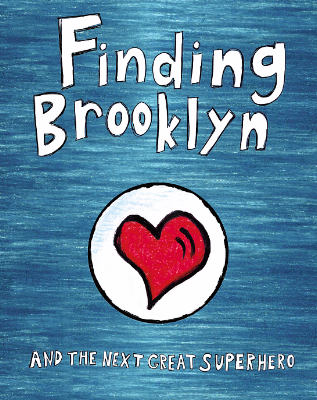
An independently published picture book about a young girl discovering what makes her “The Next Great Superhero,” Finding Brooklyn, written by Dan Sadlowski and illustrated by Allison Pierce, delves into the qualities of what makes for a great superhero. We’re all familiar with the Justice League and X-Men, but what about us? Do we have a chance at becoming superheroes?
According to her peers, there is nothing special about Brooklyn. She wears a pin with a heart on it and skeleton gloves she found one day. But that’s not special enough. Brooklyn is also a daydreamer, getting caught in class with a question she has no idea how to answer: “Who will be The Next Big Superhero?”
Brooklyn answers, “I’m not sure, but I do dream that one day it could be me.” Her peers laugh, and Brooklyn feels low. With no one to turn to, as she’s an orphan, Brooklyn remembers that superheroes must be “brave in a most troublesome hour.” When the Wickets, a super villain, enters the picture, Brooklyn steps up. Her heart button and skeleton gloves glow!
But those are easily destroyed by the Wickets. Brooklyn has to find what really makes her a superhero in this most troublesome hour. And from such a little girl, what could that be?
Brooklyn is relatable to many young and old readers. We all want to be something BIG. We all want to do something IMPORTANT. The internal journey that Brooklyn takes is one that’s familiar to almost all of us. It begs the question: What is it about us, as individuals, that make us a superhero or “AWE-MAZING”?
The plot of Finding Brooklyn is simple and straightforward: an origin story of a superhero with a villainous showdown that proves everyone wrong. While this simplicity gives way to predictable events that act as touchstones that must be addressed in any origin story, the fact that the protagonist is a girl adds to the repertoire of strong female characters. The world of superheroes is largely male-dominated, but Brooklyn’s presence and heart bring her story to life. The book leaves me wanting to know more about Brooklyn as a character and how the events in this story affect her life from here on out; much like every other superhero story—what’s next?
The art is enjoyable with pops of color in the text to emphasize certain words. There is a lot of white space, but color is used very purposefully. Only certain traits of characters are colored; the rest are black-and-white sketches. This makes the full color, yet simple palette, of Brooklyn stand out more, especially when the Wickets shows up. And when things go dark, the pages do too, dramatizing the showdown. So, while plain at first sight, it’s obvious that Pierce gave great consideration to color to provide emphasis and to set the tone for each scene.
This is a great book for young readers, who like or even dislike the more popular superheroes. The focus on the average person allows readers to relate to Brooklyn and see themselves as something more than just a “normal” person.
Find Finding Brooklyn here.

Symptoms of Being Human by Jeff Garvin
Jeff Garvin’s Symptoms of Being Human is the first book I’ve read with a gender fluid protagonist. While Garvin touches on sexual orientation, he mainly focuses on gender identity, being sure to clarify the distinction between the two notions through the characters’ interactions (mainly in the awful things people say to Riley, the main character). Riley’s attraction to Bec, a female, has nothing to do with the way Riley feels on a day-to-day basis. Furthermore, there is the distinction between being gender fluid and being transgender, though trans characters are present in the novel, as well.
Riley describes being gender fluid as being on a “dial,” which I find to be a fantastic metaphor for gender fluidity. Riley also suffers from dysphoric episodes, in which Riley doesn’t feel like the physical body the character is in. That dysphoria can come up when Riley is feeling either more feminine or more masculine but is forced to appear a certain way contrary to Riley’s instincts. Especially being the child of a congressman up for reelection, Riley is spotlighted as part of the father’s campaign as well as the new kid in school who dresses androgynously.
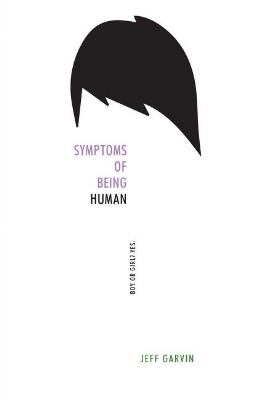
Of course, Riley has always been bullied for dressing this way. In Riley’s old and new school, there are incidents of homophobia and transphobia. People always want to know if Riley is a girl or a boy. The cover of Symptoms of Being Human even poses the question, “Boy or girl?” and answers it with, “Yes.” This itself is accurate and enticing for readers who wonder about Riley and people like Riley. In the many incidents of bullying in school and horrific assaults that happen to Riley due to other students’ attempts to reveal Riley’s sex, there is no reveal to the reader but only the story that matters. By emphasizing the horror of the assaults, Garvin essentially says Riley’s sex doesn’t matter; what matters is this happens.
I love how the reader is never told of Riley’s sex, the physical body that makes up Riley. This withholding of information keeps the reader guessing one thing and then changing their mind because of Riley’s reaction to something. This happens continuously, challenging the reader’s own preconceptions of gender and societal gender norms. Sometimes these sways in trying to peg Riley are done so subtly that the reader doesn’t catch themselves until they’re in the pitfall like everyone else. The reader becomes the judge, which is, in this case, judging the character based on what is considered feminine or masculine and why it matters enough to peg Riley as such. Challenging the reader like this is a wonderfully bold move that is eye-opening, even to those who are open to different ideas of gender and sexuality. While this technique can be seen as a trap, it’s a good trap to be in to really check ourselves and the way we view individuals.
Riley takes to blogging about gender fluidity and becomes an online source for advice for teens struggling with gender identity and sexual orientation. Feeling ill-equipped to provide advice, seeing as Riley has not even spoken about being gender fluid in person, other than to a therapist, Riley dispenses the best advice that seems valid at the time. A national incident of domestic abuse that stemmed from Riley advising a girl to return home after coming out as trans to her parents causes Riley to, again, be spotlighted. Then, in the slush of hate mail and thank yous, Riley is threatened by an anonymous person who implies they go to Riley’s school. Riley is terrified of being outed and what will happen if that happens—for Riley and for the congressman’s campaign.
Symptoms of Being Human is a very true-to-life narrative of what some people feel like. It tells a story about gender in a way I don’t think many people have read before. And while Riley’s physical description is ambiguous, there is no shortage of connection to this character and what Riley goes through as a gender fluid person. In fact, character relatability and hope for Riley is what draws me to the story. I feel like I know Riley really well, just as I would expect from any other novel.
Find Symptoms of Being Human here.

My Lesbian Experience with Loneliness & My Solo Exchange Diary by Nagata Kabi

As graphic memoirs are trending, especially ones written and drawn by webcomic artists, Nagata Kabi’s My Lesbian Experience with Loneliness and her sequel, My Solo Exchange Diary, stand out as queer stories with quite a bit of frankness. Kabi does NOT hold back when discussing her bouts of anxiety, sexual frustrations, awkward and unhealthy familial bond, and of course loneliness. These books illustrate Kabi’s experience as an adult navigating life as a Japanese college dropout living at home with her parents.
Living at home as a 28 year old may not be anyone’s dream, but sometimes that’s where life drops us. After leaving college, Kabi tries to hold down part-time jobs, but her anxiety and depression get in the way. She can’t seem to get out of bed on most days or even eat, spiraling Kabi into a terrible eating disorder. She loses her sense of self, which to Kabi means having security, direction, and purpose. But most importantly, she cannot find a sense of belonging.
Without knowing who she is and where she’s supposed to be, Kabi wallows in grief, disrupting her stability and further disappointing her parents, who seem to only care about Kabi getting a full-time job. Through this, Kabi also deals with loneliness and a lack of physical intimacy. Therefore, Kabi seeks a lesbian escort agency, but when she meets with the escort, it’s not what Kabi expects. She isn’t “cured” in any way but instead plagued with more questions about the way she doesn’t communicate with people outside of her family, fostering a rather Freudian attachment to her mother.
My Lesbian Experience with Loneliness not only focuses on Kabi’s sexual repression and awakening but mostly her journey toward self-awareness and self-love, digging her way out of the hole of mental illness, and gaining independence. This is also the case in My Solo Exchange Diary, in which Kabi discusses the aftermath of putting out her debut manga into the world and what’s happening during and post-publication. The reader is privy to the artist’s struggles of creating My Solo Exchange Diary, which is pretty cool and meta.
In the sequel, Kabi works toward communicating with past friends and trying to separate herself from her parents, particularly her mother, who falls ill. Kabi is still dealing with many of the same pains as she does in the first book, which may seem redundant but rings true to life. Kabi moves out, but quickly moves to another apartment, and then moves back in with her family. She recognizes this cycle as similar to the one when she couldn’t hold down a job. Soon, she realizes what responsibility, independence, and unhappiness really means for her.
Throughout this book, Kabi struggles with her relationship with her mother. She wants to be independent but is really reliant on her and wants to please both parents. Her mother even calls Kabi’s debut, My Lesbian Experience with Loneliness, something to be ashamed of. At the same time, Kabi is still struggling with loneliness, being 29-years-old and having never kissed someone she likes and likes her in return. The idea of loving and being loved is the new aspect in the sequel. Kabi’s quest to find this in a friend she is reunited with, the same lesbian escort agency, and a new acquaintance is the refreshing newness the sequel needs to not be overly repetitive of the first book. Kabi begins to understand her loneliness and the need to love oneself in order to boost her self-esteem. While she still struggles with anxiety and depression, she overcomes some of her ill-fated thoughts of herself. This book is about the journey toward finding oneself in the midst of success yet impending loneliness.
Nagata Kabi has a unique way of illustrating her battles with mental health, particularly in the way she often draws the person she wants to be and a persona of her mind telling her to do whatever it takes to please her parents. There are many images of this persona literally holding back another Kabi, who is reaching for something far away. Kabi also uses black and pink strokes against a white background to illustrate the doom she feels inside her head. Kabi’s images are often literal depictions of philosophical or mental states of anxiety and dilemmas. They are coupled with big, harsh dialogue bubbles (more like large spiky things to emphasize her inner screaming) that describe her thoughts. She isn’t afraid to overuse ALL CAPS AND EXCLAMATION POINTS!!! when illustrating these thoughts, which makes the comic authentic to Kabi’s actual mental state. While the constant usage of these techniques and her setbacks are redundant, this rings true to the side effects of depression and anxiety. Sometimes it feels like one is in a constant state of doom or in a cycle one cannot escape. This book makes the reader experience that nature, which becomes somewhat frustrating, thus perhaps eye-opening to these mental health problems.
Both of Kabi’s books are self-reflective in nature, including narrative commentary from the present Kabi about her past thoughts and emotions. She often says things like, “Later I would learn…” or “Now I know…” The reader is engaging with the musings of the creator, which is not unique to graphic memoirs but gives the reader the idea that one is always learning. And now that this is a series with another book set to be published in 2019, the reader is left wondering how Kabi is doing now and what has developed in her outlook on life and the progress she is making for herself.
Find My Lesbian Experience with Loneliness and My Solo Exchange Diary here.

The Subtle Art of Not Giving a Fuck by Mark Manson

Just what I need at the moment: to not give a single fuck but to do so subtly! After hearing the hype around Mark Manson’s The Subtle Art of Not Giving a Fuck, I knew I had to find out how to not give a fuck because my life is a clusterfuck. Though, Manson would consider me seeking and then reading this book as giving a lot of fucks about fuck giving, pulling me into what he calls the Feedback Loop from Hell, because my actions to seek self-help or guidance acknowledges and focuses on the fact that I am lacking in something and am eager to find it—a chill pill.
Manson’s self-help book is full of paradoxes, but once you think about what he’s saying, some of it actually makes sense, like how self-help books mainly emphasize what you lack. Like I said, the existence of this book is itself a paradox because it emphasizes how I care too much about too many things or that I care about the wrong things, my priorities not aligning with my values.
For many situations in which we find ourselves caring too much or in desperate need of escape, Manson uses the “backwards law,” coined by philosopher Alan Watts, which basically points out how we get the opposite result we desire or generate even more problems from doing what would logically, on the surface, make sense. With this law, Manson frankly explains how exactly our actions backfire on us and what we should do instead.
The main topics Manson covers are: the values and metrics (standards) by which we measure ourselves, taking responsibility for what happens in our lives even if what happens is not our fault (how we interpret and respond to events, and how we use our own victimhood), being comfortable in uncertainty and being wrong in order to seek answers in order to grow, seeing your failures and problems as mundane which would make them seem less overwhelming, seeing action as progress even if it results in failure, and accepting our mortality and ridding ourselves of entitlement / do-nothing victimhood in order to refocus our values and priorities to match our actions.
Manson’s The Subtle Art of Giving a Fuck is fun and funny and blunt. Give this book a read if you’re willing to try to understand a different way of thinking, the “backwards law,” so you may reconsider the way you act in various situations, during which you are confronted by questioning your values and standards. This isn’t the book that will tell you how to keep your life in order or how to fix everything in your life. This book will help you figure out what to give a fuck about.
Find The Subtle Art of Not Giving a Fuck here.

For Every One by Jason Reynolds

Jason Reynold’s For Every One is not a book of poetry or a novel in verse, like the thrilling page-turner, Long Way Down. For Every One is one poem in four parts addressed to dreamers, those who dream of doing something big or life changing or even something small that they haven’t tried before. The poem is about being brave and taking steps to become better than you were yesterday and not giving up if you didn’t make it as a millionaire by age twenty-five. The poem is about what “making it” even means and what’s on the other side of “making it,” how he—Jason Reynolds—has yet to “make it.” I know, right?
Reynolds writes, “I don’t know nothing about that. / I haven’t gone through it all / and come out on the other side.”
Easily read in one sitting, For Every One sounds like a graduation speech of truth. You may not reach all of your goals, for they may be loftier than you first thought, but “jump anyway.” This poem is a motivator, nothing you haven’t heard before if you graduated college or high school—hell, probably even middle school.
However, Reynolds’ free verse is as disembodied and free-flowing as he urges you to be. His experimentation with lyricism and form pop up every now and then, which made me Ooo and Ahh, but those moments were rare and I had to remember this poem isn’t supposed to be as tormenting and gripping as Long Way Down. His play on words and their meanings give it that graduation speech vibe, and he even calls the poem a “ramble” at the very end.
Now, whether or not this is a meaningful ramble rests on the shoulders of the reader. If you’re going through a big life change or you need a push to take the leap, then maybe you need to read this. Or have someone read it to you. Or have Jason Reynolds read it to you himself because I’d feel pretty damn motivated after that.
Find For Every One here.

The Summer I Turned Pretty series by Jenny Han

Jenny Han’s The Summer I Turned Pretty series is her first trilogy she published solo, and it is certainly the YA summer beach read you have been looking for: a love triangle, tender lifelong friendships, and family drama—all that will have you laughing and crying on cue.
Belly Conklin has spent every summer in a beach house at Cousins with her mother and brother, Steven, as well as her mom’s bestie, Susannah, and her sons, Conrad and Jeremiah. Belly has also always loved Conrad. It has always been him. However, he doesn’t take note of her in a romantic way until much later, when he is away at college and their relationship is distant, like his personality, and their relationship falls away.
Months later, Conrad is missing. Jeremiah reaches out to Belly for help, though she has no idea where to find Conrad. They go to the one place they both know best. When the beach house is threatened, Conrad wants to save it. It’s the only thing he feels he has left. At least, Jeremiah and Belly have each other, and soon, they’re the ones in love.
Every step of the way, the kids have always had the support of their mothers, but with Susannah out of the picture, the fathers in the picture, and Belly’s mom not on her side, everything is complicated and way too overwhelming. Everything had always seemed like too much before, but together, the Conklin’s and the Fisher’s have always powered through. Now that the families are torn apart and relationships are at stake, all seems hopeless.
Jenny Han’s trilogy is cute and beachy and great for relaxation in the summertime. For me, I’ve been piling on the heavy-duty reads, so this has been a breath of fresh air. It was nice to not have too much emotional turmoil but still have an investment in each of the characters by the end of the first book. However, I do wish there was more between Belly and her best friend from home, Taylor, since there are scenes with Taylor and Belly does go back home and spends time away from Cousins. I’m still not sure why they’re even friends. The central characters are so well-developed and likable while still being flawed, which pushes the story forward and makes you focus on the two families in this coming-of-age series.
While each book can stand alone, the series as a whole covers the entirety of the love triangle and the family’s dramatic twists and turns, especially the relationships between Belly and her mother, which is really relatable. The plot in each book is different. The first focuses on the two families and one summer in particular. It shows the dynamic between these families and how they have grown up together, so there’s that tropey romance of “that boy you’ve known since you were in diapers, but now you’re both all grown up”. The second book is the twist. NO SPOILERS! Well, minimal spoilers: there’s a love triangle, and here is where the plot begins to shift more toward romance and away from the other aspects the first book also had. In the third book, those other aspects come back in regards to Belly’s romance, as does the love triangle in full force. While the characters themselves and the plot itself wasn’t very YA, the emotions definitely were, and the book still very much read like YA. Teens can still relate to Belly and the other characters just as much as they did in the first two books.
Overall, I thought this was a nice step outside my usual reads. It was a comfort and fast flip, and frankly, it was kind of nice to not feel so strongly for fictional characters for once. So if you are a fan of Jenny Han or a fan of sentimental or easy yet substantial and meaningful reads, I highly recommend The Summer I Turned Pretty series and also check out Jenny Han’s other trilogy, To All the Boys I’ve Loved Before.
Find The Summer I Turned Pretty series here.

Speak: the graphic novel by Laurie Halse Anderson and Emily Carroll
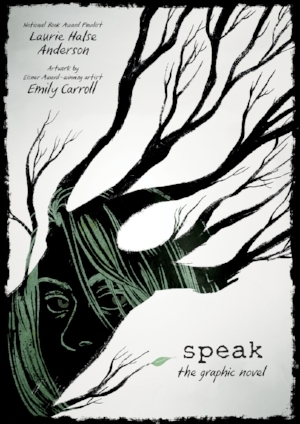
Speak by Laurie Halse Anderson is a personal inspiration of mine, let alone a widely acknowledged canonical novel of modern times. And now, with the artistry of Emily Carroll, it has become a graphic novel. Carroll’s black-and-white drawings bring a rough and edgy atmosphere to the text, emphasizing the interiority during the scenes in which Melinda vividly recalls what happened to her the night of party. Carroll takes these moments and gracefully yet devastatingly depicts the horror in a way that is frightening but may not be as triggering for some readers as they would think, though anxiety still rattles the bones.
As a whole, Speak: the graphic novel reads much like how a movie adaption would be seen. The main character is much more melodramatic, but somehow we still lose much of Melinda’s interiority about the incident that shakes her to her core. The graphic novel seems to revolve so much around other subplots and Melinda’s external relationships that the main plot of the assault is buried. If I hadn’t read the original Speak, I may have forgotten the main point of the novel. First, there’s the new girl Heather, losing Melinda’s old friends, art class and drawing trees, Melinda’s poor grades, family dysfunction, in-school suspension, rules of the school and bullying, etc. There’s so much that distracts the reader from Melinda and her journey of recovery that is more focused in the original novel that is missed in the graphic novel.
My guess, as a reader and a part of the industry, is that the goal of Speak: the graphic novel is to grasp onto the gaining popularity of graphic novels at the current moment, capture the new generation of readers, and gear them toward reading the original Speak. I’m not against this method. I think this is a great way of repackaging a modern classic, but lovers of the original novel shouldn’t expect grand changes but enjoy the wonderful artwork by Emily Carroll.
This novel is still relevant today. Teachings of consent is still needed today. If you haven’t already gotten your hands on one of them, I highly recommend one or both of these books.
Find Speak: the graphic novel here.

Queer: A Graphic History by Meg-John Barker and Julia Scheele

Meg-John Barker’s Queer: A Graphic History is very properly named. With comic illustrations by Julia Scheele, Barker provides an overview of the history of queerness, citing many players involved in queer activism and queer theory. This book is best used as a reference book or a springboard to delve into the many, many avenues queerness has taken over the years. I especially think it’s a good book, in an academic sense, for an introduction to queer theory, or queerness, or gender/sexuality studies. Readers and students can learn a lot from specific pages and then launch into their own research from there. In addition, Barker provides a Resources section of her research as well as other resources that may be helpful. As for a cover-to-cover read, well, there’s a lot to take in.
First, Barker defines the word queer and its use as different parts of speech, including a noun, verb, and adjective. What’s important here is how scholars and people queer an idea, or turn an idea around, twisting it into something different or strange or something one hasn’t thought of before, which can bring about change and positive thinking.
Barker then breaks down the differences between identity politics and queer theory; gender, sex, and sexuality; nature and nurture; and sex and gender. Most important here is the shift in the notion that the meaning of sexuality went from one of behavior to one of identity based on attractions and sexual preferences. To cover these topics, Barker along with Scheele provide a detailed yet concise overview of queer theory and activism (the gay rights movements similarities to black feminism and the struggles of multi-marginalized peoples) as well as key figures and thinkers in conversation with one another.
To make these ideas more accessible to the reader, Barker and Scheele put these ideas in cartoons and pop culture references. Barker claims queer theory is known to be hard for most people to understand and is full of multiple binaries to diffuse the idea of binaries, thus making itself contradictory and making it inaccessible to the common person, which is why it has not been as widely recognized as other fields of study. Barker concludes with the hope that this book makes the introduction to queer theory and queerness a bit easier to grasp, which it can when taken in small doses, like a reference book. Whether or not this book is successful is in how the reader uses the book and their explorations from there.
Find Queer: A Graphic History here.

Burro Hills by Juila Lynn Rubin with Interview!

Burro Hills by Julia Lynn Rubin is a ferociously wild ride, one that will leave you with whiplash but also wanting more! With an eccentric cast of characters, there is never a dull moment in this town. From high school gossip to household dramas to drug trafficking, we follow an unexpected group and are given small breaths of reprieve throughout the novel. In this way, it almost feels like the reader is on this high with the characters, mimicking the bursts of adrenaline.
The story follows Jack, who sticks with his pot-smoking crew and his other best friend Jess. However, the new kid, Connor, rattles the status quo of the group, tearing Jack’s attention away from his friends. Connor seems to know exactly who he is: a kid who gets into trouble—oh, and he’s bisexual. On the other hand, Jack absolutely doesn’t know who he is. By spending time with Connor, Jack opens up and reveals to himself who he really is.
However, what about his old friends? They don’t forgive him for ditching them. And in a town riddled with homophobia, crime, and vengeance, there is no safe space for Jack—not even in his own home, where his dad is a drunk and his mother has a problem Jack cannot understand.
The following is an interview with author Julia Lynn Rubin:
CL: Congratulations on an amazing debut novel! Each character has so much depth, and they all jump off the page as realistic people. What made you write about a group of teen boys?
Julia Lynn Rubin, photo via www.julialynnrubin.com
JLR: Thank you so much! That is such high praise and I’m so flattered! I think I’ve always been fascinated by teen boys and why they say what they do, act how they act. It wasn’t a conscious decision when I first started the novel, but as I kept writing, it evolved into this deep-dive exploration of toxic masculinity. I had a lot of fun with their dialogue and characterizations and making them as “awful” as possible on the surface, while examining how sensitive and confused they are underneath all that exterior bullshit. Basically, in different circumstances, these boys wouldn’t be “bad.”
CL: This was a very interesting read for me since I know you personally. So I want to know which character you think you align with the most and why.
JLR: It’s definitely Jack. He’s the most autobiographical character to me, emotionally at least. I remember my dad read an early draft of the book back when it was a dual point-of-view between Jack and Jess, and he said: “You’re not Jess. You’re Jack.” That stuck with me, and helped inform my decision to make him the sole POV character when my agent and I were revising. He’s sensitive, anxious, thoughtful, observant, and a little too wrapped up in his own interiority to the point that he sometimes misses the obvious and misreads the situation. His cognitive distortions are all too familiar to me.
CL: You really put these characters through the wringer. People say to make your characters go through hell, to make the worst possible things happen to them in order to incite drama and conflict, and you do exactly that. Was there ever a moment in which you or your editor thought there was too much going on that the story would be found unbelievable? Did you have to pull back?
JLR: I remember revising and thinking, “I feel so bad for what I’m doing to these characters.” I even said that to my editor at one point. There are a handful of scenes and moments I kept second-guessing, wondering if I should put them in a YA novel since they’re so damn disturbing (though I know teens can totally handle it). But it’s true, you really have to up the stakes, especially in a character-driven story. And these characters are teenagers, so everything feels very life and death to them, very immediate and all-consuming. I actually had a few major scenes that I ended up either cutting or completely rewriting because they didn’t feel as believable in retrospect. I don’t want to spoil anything, but the whole final scene with Toby’s family was originally much different and maybe a little unrealistic and unsatisfying. I also spent a lot of time with my editor fleshing out Jack’s parents and making them feel like fully realized people, less like caricatures. But I never really pulled back, no.
CL: Now, I know you from The New School in New York City and we both also spent time in Pittsburgh, PA. From where did come up with the setting of Burro Hills? Is it based on anywhere in particular?
JLR: Yes! Small world. Actually, growing up on the East Coast made the decision to set the book in Southern California all the more tantalizing. I’ve always been fascinated with the West Coast and the climate and culture of Southern California. In high school I wanted to go to film school and move to L.A. and become a director. I visited with my mom to check out colleges and I was totally enamored. That’s probably where that setting originated, that and the way Janet Fitch describes it in White Oleander, a novel I’ve re-read many, many times. But I created a fake town so I wouldn’t offend anyone! The setting is also based on my perception of urban sprawl and dying towns and nowhere places; the beauty in the ugliness of America.
CL: In this book, there are themes of sexuality, friendship, broken families, drug use, coming of age, and so much more. What would you most like your readers to get from reading this book?
JLR: I think the great thing about books is that each reader takes away what they need to and sees what they want to see. I love that about art. I know everyone is going to have a different experience reading my book, but I really hope those who read it – teens especially – come away with a sense of being seen, and heard. And hope.
CL: Can you reveal what’s coming up next for you?
JLR: I’m currently on submission with my second YA novel (which I wrote at The New School), so fingers crossed that one lands somewhere!! I also have another YA in the works that was my MFA thesis, and an idea for a fourth. So basically I’m going to keep promoting my debut and writing and hoping and praying.
CL: Thank you so much, Julia, for answering these questions! I can’t wait to see what you do from here.
JLR: Thank you so much for having me! These were excellent questions.
Find Burro Hills here.
Follow Julia Lynn Rubin on Twitter!

Emergency Contact by Mary H. K. Choi

Mary H. K. Choi’s YA debut novel Emergency Contact starts with Penny Lee going away to college, making this book perfect for older readers of the genre. We are no longer in high school but get a taste of freshman year in a completely different context. Penny’s roommate, Judy, is the pinnacle of a spoiled rich girl. Judy’s best friend, Mallory, is by association, a roommate, as the two friends are basically attached at the hip.
Much of the emotional and romantic inclinations are similar to those of younger people. I mean, college freshmen were just high schoolers four months ago. Penny is a sci-fi/fantasy writer and still feels like the “goth kid.” Penny is regimented, waking up early to write while Judy is asleep, attending all her classes, and of course avoiding her really vicarious mother Chloe.
However, when Judy invites Penny to the coffee shop, she meets Judy’s uncle, Sam, a young twenty-something taking film classes to become a director. Sam has tattoos. Sam is older. Sam wears the same shoes as Penny. Penny is in awe. But none of Judy’s friends can date her uncle (though he is no longer, as that divorce happened a while back)! That’d be weird.
When Penny finds Sam in deep distress one night, she takes care of him and brings him to the coffee shop, which, unbeknownst to Penny, is his home. From then on, they become each other’s emergency contact. They talk about what they’re working on and their lives, especially when one needs an ear to listen (or read—most of their communication is via text, which does sometimes get a tad confusing).
It’s sweet how they rely on one another and we see their relationship blossom into one of dependency, though it fosters reliance as the foundation of their romance, which made me wonder how healthy this whole thing is. But I fell for it anyway! They’re each other’s rocks, and once they meet again in person, their relationship becomes more real rather a strange Internet-type of romance. This novel is definitely character-driven, though there are plaguing obstacles the two deal with together and separately. If you’re into a book with a witty voice that makes you laugh at the seriousness of life’s woes and love artistic quirk, you’d be totally hooked by Emergency Contact. Escape from your own worries, and dive into theirs. At least for 400 pages.
Find Emergency Contact here.

Depression & Other Magic Tricks by Sabrina Benaim
Depression & Other Magic Tricks by Sabrina Benaim
Sabrina Benaim’s debut Depression & Other Magic Tricks is a phenomenal punch in the gut that I masochistically want to read again and again. Other than the catchy and paradoxical title, I was enraptured by her explosive presence on Button Poetry’s YouTube channel. Her poetry is even more powerful on the page.
In “explaining depression to my mother: a conversation,” Sabrina explains depression and anxiety in a way that will have many who suffer from these ailments saying, “YES!” With passages, such as:
my depression in a shape shifter;
one day it is as small as a firefly in the palm of a bear,
the next, it’s the bear.
those days i play dead until the bear leaves me alone.
This is me. This is my depression: a firefly and a bear, and me in the middle of all that shape shifting. For me, I need poetry like Sabrina’s to reach me in solidarity and comfort, especially when I’m in my worst moments. It soothes me like a blanket in the wintertime.
However, Sabrina also has poems that uplifts, such as her poems to her muse, Beyoncé! Who doesn’t love poetry about Queen B? In this way, Sabrina is able to latch onto a larger audience, to be more accessible to a mainstream market, in order to sway readers with her magic tricks toward the heavier topics of depression and what goes on in the mechanisms of her mind and possibly the reader’s.
A throughline of poems are Sabrina’s magic trick poems, such as my favorite “magic trick 002”:
she willingly thrusts her body onto the hook
all for a better look at the stars.
Sabrina’s honesty is beautiful, as is her language in metaphor and scene. I find myself sighing over and over again at many of her lines that make me feel lost at sea yet also at home.
Find Depression & Other Magic Tricks here.

Love, Hate and Other Filters by Samira Ahmed

Samira Ahmed’s debut novel Love, Hate and Other Filters channels the cultural struggles of an Indian-Muslim-American girl, who just wants to be her own person. Maya Aziz feels most comfortable behind a camcorder, filming her life in its quiet monotony. Except now that she is about to graduate high school, her life is anything but monotonous. First, her mother is bent on finding a suitable young man for her to marry. Then there’s Maya’s secret acceptance to NYU Film School. And lastly, there’s Phil, the jock Maya has been crushing on for years, and he’s finally noticing her.
“I don’t want to hide anything, and I don’t want something… expected. I want to go to film school and be the first Indian American to win an Oscar, and then I can meet the One and fall in big, heart-bursting love, and we’ll travel the world, my camera ready to capture out adventures,” says Maya.
However, this nightmare of a maze turns even more horrid once a terrorist attack thought to be committed by a Muslim instigates attacks on Maya and her family. The stakes are raised even higher, and tensions between Maya and her parents and the rest of Maya’s peers are about to burst.
Ahmed shines a light on a specific culture from the perspective of an insider. This is not a White narrative for activism; this is a personal story based on the very real conflict between America and the Muslim community. Ahmed doesn’t hold back when expressing the fears of a community that has been a major target since 9/11. This is what we need: book with strong narratives written by strong voices that can personally speak to minority experiences.
Find Love, Hate, and Other Filters here.

Lumberjanes: To The Max Edition Volume 1
Lumberjanes To The Max Edition Volume 1
Written by Noelle Stevenson & Grace Ellis
Illustrated by Brooke Allen
Colors by Maarta Laiho
Letters by Aubrey Aiese
Design by Scott Newman
Forward & Afterward by Raina Telgemeier

With Maarta Laiho’s bold palette of colors, Lumberjanes is a punchy, quirky, and punny comic book series that focuses on five Lumberjanes (basically, the Girl Scouts but with Boy Scout woodland activities), who can’t seem to ever follow camp rules. There is always something more interesting to pursue than staying in the Roanoke cabin, like fighting holy kittens, were-bears, and a river monster.
Using the qualities that make up a true Lumberjane, as stated in the pedantic field manual, Jo, April, Molly, Mal, and Ripley try to beat the mysterious creatures before their cabin leader, Jen, can find out they’re gone. This is a true case of drama finding them. Pretty soon, even Jen is roped into the mayhem when one of the Lumberjanes turns out to be a mythological character bent on beating her brother to obtain ultimate power over the world. Now the girls of the Roanoke cabin have to save all of humanity from a couple of greedy gods.
In the first volume of The Max Edition, young and older readers will laugh out loud at the characters’ antics and will flip through the pages to find out what havoc is on the next spread. With a twist on gender stereotypes and a subtle romance, Noelle Stevenson, Grace Ellis, and Brooke Allen’s Lumberjanes is all about “Friendship to the max.” And, of course, earning those cool camp badges. Lovers of Noelle Stevenson’s Nimona (HarperCollins) will also enjoy this feminist, kick-butt series.
Find Lumberjanes To The Max Volume 1 here.